[Click HERE
for a larger picture of the scoreboard]
The parish
of Ashby St Mary is situated in the county of Norfolk
in the region of England known as East Anglia.
It is one of 118 towns and parishes within the local
authority area of South Norfolk District Council.
The parish lies approximately 7 miles south east of
the city of Norwich. The village is bordered by Thurton,
Claxton, Bergh Apton and Carleton St Peter. It
is located to the north east of the A146 road that extends
from Norwich to the most easterly point in England at
Lowestoft.
Ashby was named after all the ash trees that grew in
the village. St Mary was the name of its church so the
village eventually became known as Ashby St Mary. The
parish covers an area of almost a square mile at just
under 204 hectares. As at 2006 it comprised
about 125 dwellings with a population of approximately
300 inhabitants.
If
you are interested in ancient relics, ruins, old
coins, land markings, and earthenware fragments
then this page deserves viewing.
The 'finds' occurred within parts of local parishes
including Ashby St Mary, Carleton St. Peter, Chedgrave,
Claxton, Hellington, Langley, Rockland St Mary,
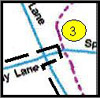
and Thurton. Two documents list the 'finds' made
within those areas while two maps show the position
of each list entry. There is even a reference to
the discovery of an engine from a crashed aircraft.
See
some of Ashby's history including pictures and other
exhibits supplied mainly by parish residents over
the period of 9-11th July 2010. Contributions of
any village memorabilia were invited to be submitted
and placed on show at a specific village occasion
for the purpose.
It provides information from the 1800s and a snapshot
of village life from the early 1900s onwards.
TIMELINE AND FEATURES - CIRCA 4000-2500 BC
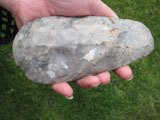
In late February 2011, Mike Harris was ploughing his
field in Ashby when he caught sight of an object that
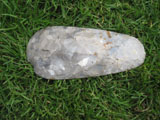
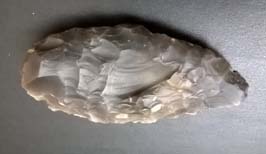
turned out to be a Neolithic Axe Head.
The Norfolk Museums and Archaeology Service in Norwich
issued the following information about Mike's find. "The
object is a part polished axe. The dimensions are 159
x 72 x 34mm (approx 61/4" long x 27/8" high
x 13/8" thick). It has a rounded polished cutting
edge at the widest point with the polish extending up
to the mid length. It has a flaked broad and rounded
butt. The flint is pale grey, speckled and with little
patination, but has scattered spots of iron staining.
Apart from a small chip on the cutting edge the axe
appears to be complete.
Polished, part-polished and flaked axes of this form
are characteristic and diagnostic of the Noelithic period
when, with the introduction of agriculture there was
the need to clear scrub and trees from the land."
Showing
axe head size Note
the chip on left end
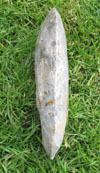
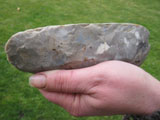
Top edge Top
edge - side view
Mike was told the axe head was probably
discarded due to the chip on the cutting edge. With
thanks to Mike for contributing to part of Ashby's history
- it is surely ironic that he was doing with a plough
what others did over 4-6000 years ago with axe heads
like this one.
- CIRCA 4000-2500 BC
A former resident, Marianne Grayson, found the Ashby
website, and in November 2015 she wrote -
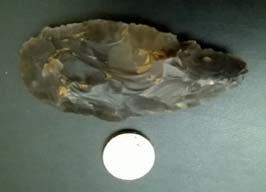
" I saw on your website the neolithic axehead found
in Ashby in 2011. I thought you might be interested
in my own Neolithic Ashby find, from
1975 (when I was 11 years old), and the letter I had
from the Museum about it, which confirms it was from
just the same period as Mr Harris's find. It's smaller
than his axehead (the coin is a pound coin, for size).
I found it in the field behind the church - I can't
remember what I was doing there at the time - not ploughing
anyway - but ever since, when walking in fields with
flints in I've always looked out for, but never found,
another. I lived at Ashby Rectory as a child and teenager
from 1973 - 1982 when my father, Kit Chalcraft, was
vicar.
In a letter dated 13th January 1975
the following information was provided by the Norfolk
Museums Service -
"I return with thanks the flint which you sent
us via Mr Rose of the Norfolk Archaeological Society.
I am very grateful for being allowed to see it,
especially nas it the first object reported to us from
that particular spot and may indicate a habitation site.
It is of the Neolithic or New Stone Age, between 4000-2000
BC. Objects of this sort are known as 'Leaf
shaped points' and were used as knives or spearheads"
- CIRCA 1000 AD Ashby St Mary was referred to in the Domesday
Book when it was drawn up between 1084-86. At that time
the parish was known as Ascebei. Two
principal landowners in the area held parcels of land
as a direct tenancy from King William the Conqueror
in right of “Knight’s services",
this being the provision of a contingent of armed soldiers
when required by the King. These two chief
tenants were Roger Bigot and Godric the Steward.
The next tenant in the hierarchy under Roger Bigot was
Robert of Vaux. In turn Robert of Vaux was Sweetman.
It seems probable that Sweetman was an Anglo-Saxon and
not a Norman since he is recorded in the Domesday Book
as having held land in Ascebei before the Norman Conquest.
Under Sweetman there were “10 freemen …
at 30 acres. Always 1 plough; meadow, 2 acres”.
Sweetman’s holding also included “7
halves-a-freeman, at 27 acres. Always 1 plough.”
In the other part of Ascebei, the immediate tenant under
Godric the Steward was Ralph. Under Ralph there were
“6 whole freemen and 6 halves under the patronage
of Aslac and Leofric, at 20 acres of land. Always 11/2
ploughs.” Godric’s land also included
parcels mainly in Claxton “under the patronage
of Edwin” which also brought in a further
“freeman and a half, 5 acres” in Ascebei.
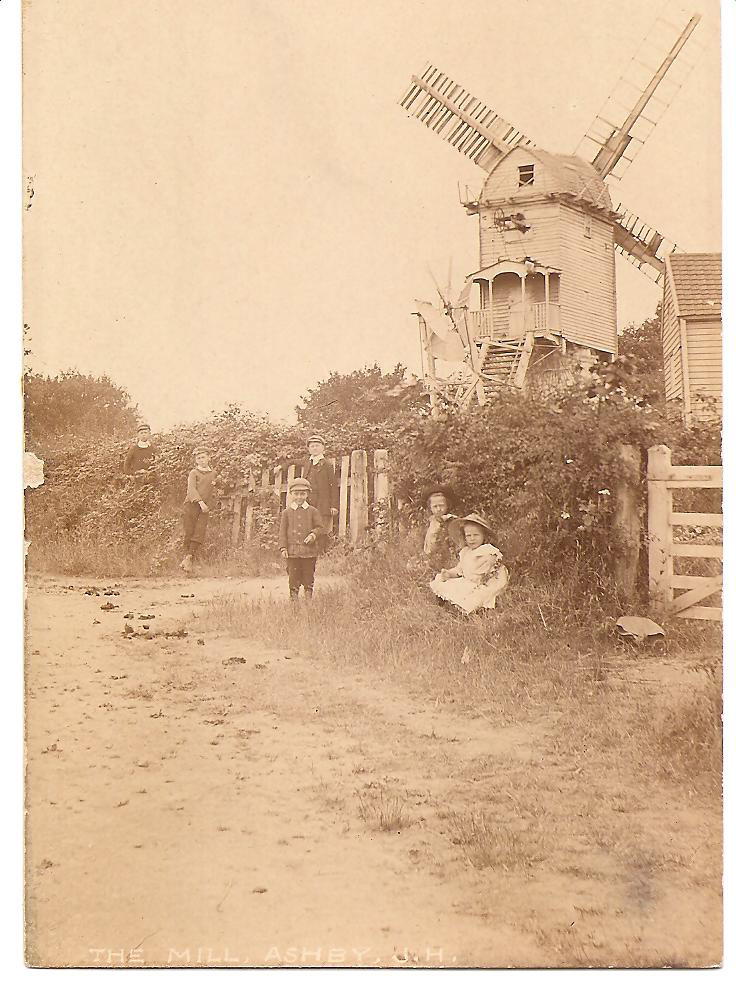
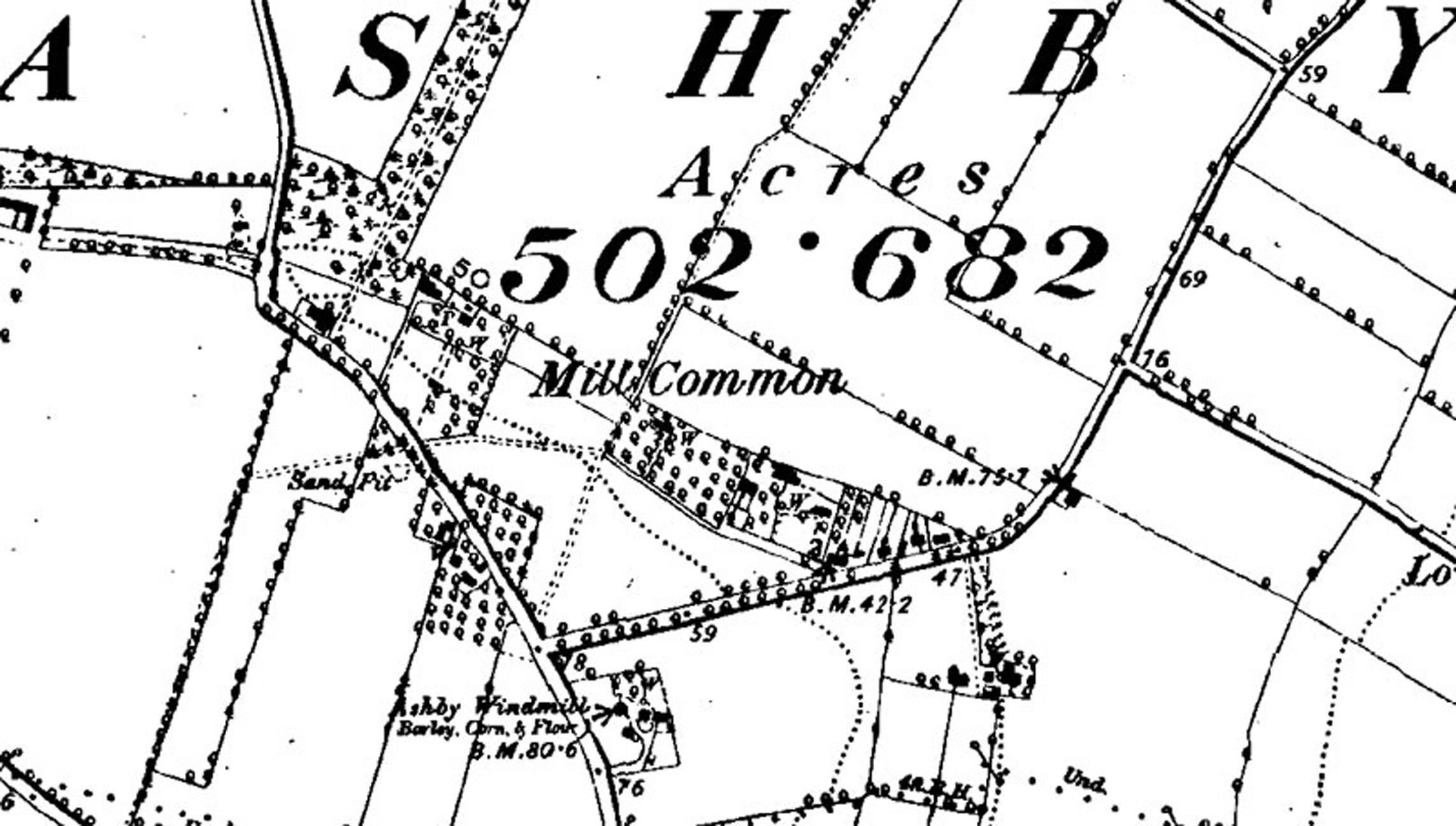
- 1757 ASHBY MILL
For
a fine scanned photo (in sepia)
For
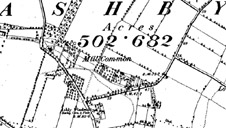
a larger map of the former
of
the above picture, click HERE
Ashby
Mill site, click HERE
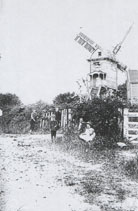
Ashby St Mary Postmill is recorded
as having been constructed in 1757. Evidence shows that
until the 1st World War, the windmill (see Gallery below
for picture) used to stand opposite the present site
of the Ashby St Mary village sign. Information taken
from Whites and Kelly’s Directory of Norfolk indicates
the Mill was owned by William Young in 1845, by John
Rushmore in 1864, by Daniel Burroughs in 1883, by Frederick
George Chapman in 1901 and by Albert Arthur Culling
in 1916. It is understood that a parishioner’s
father, born in 1902, recalled that on a journey from
Thurton School to his home in Sandy Lane, witnessed
the Mill being pulled down by a traction engine, which
also places the existence of the Mill up to 1916 or
beyond.
- 1854
The following entry appears in the History, Gazetteer
and Directory of Norfolk, 1854 "Ashby parish contains 249 souls, 58 houses,
and 485 acres of land and is situated 3 miles N.N.W.
of Loddon, and 71/2 miles S.E. by E. of Norwich. Robert
Gilbert. jun., Esq is the chief landowner; there are
also several smaller land proprietors, but Sir Chas.H.Ric,
Bart is lord of the manor, and he and Sir W.H.Proctor
are alternate patrons of the rectory, valued in the
King's book at £6 and consolidated with Carleton
St. Peter. The Church, dedicated to St. Mary,
is a spacious edifice, with a square tower and three
bells. In 1843, it was thoroughly repaired, new windows
added, and seatly fitted up with open seats. There are
28 acres of glebe, and the tithes are communted for
£176 per annum.
Directory:- Rt. Gilbert, jun.,Esq., the Hall ; Rd. Eldon,
wheelwright ; Mrs Amelia Maillet, Ashby House ; Rev.
David Pegg, (Baptist) ; Isaac Shreeve, shoemaker ; Wm.
Todd, butcher ; Wm Young, corn miller ; and Goe, Basey,
Wm. Goodram, Daniel Mansfield, Jas. Mays, and Jac. Smith,
(and parish clerk), farmers."
[Source:www.historicaldirectories.org-History, Gazetteer
and Directory of Norfolk 1854, Loddon Hundred, page
517]
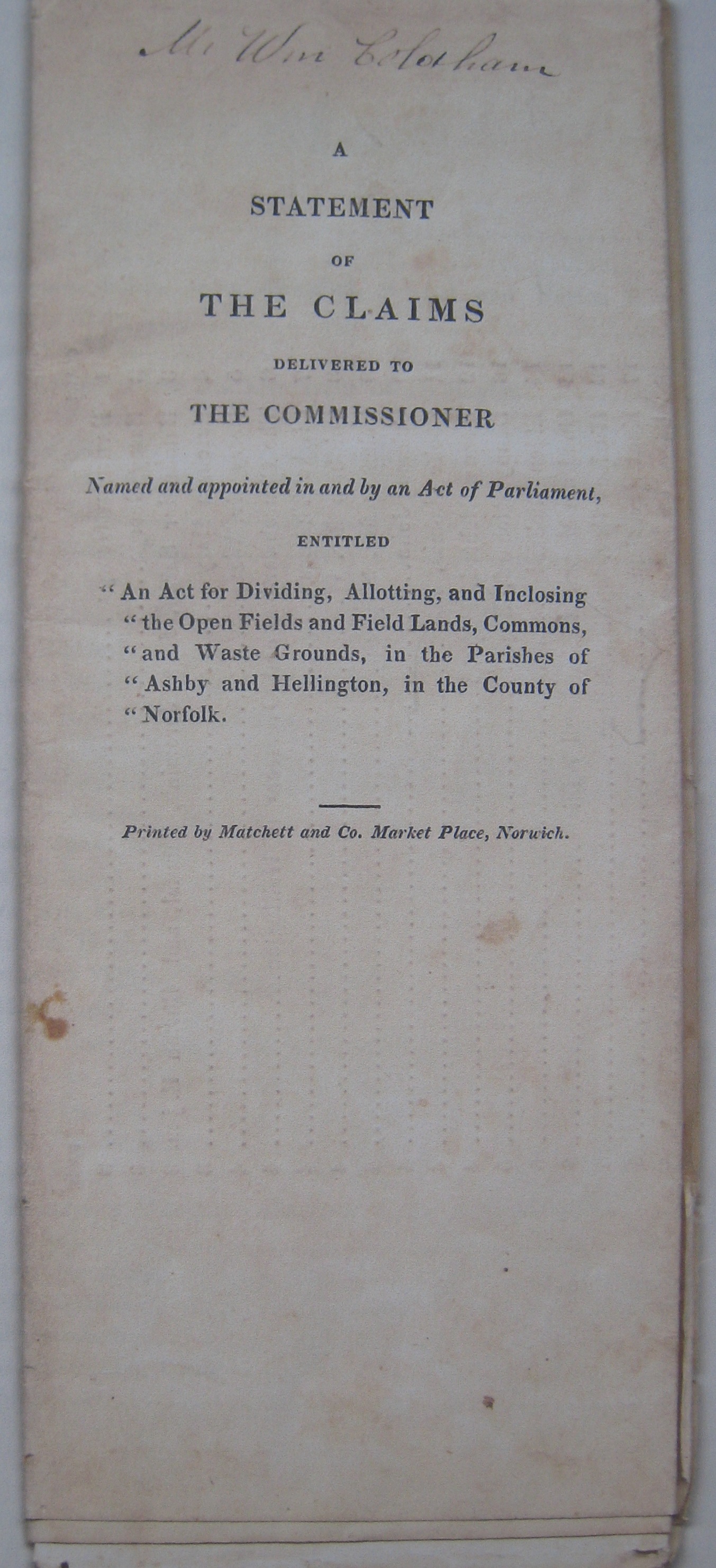
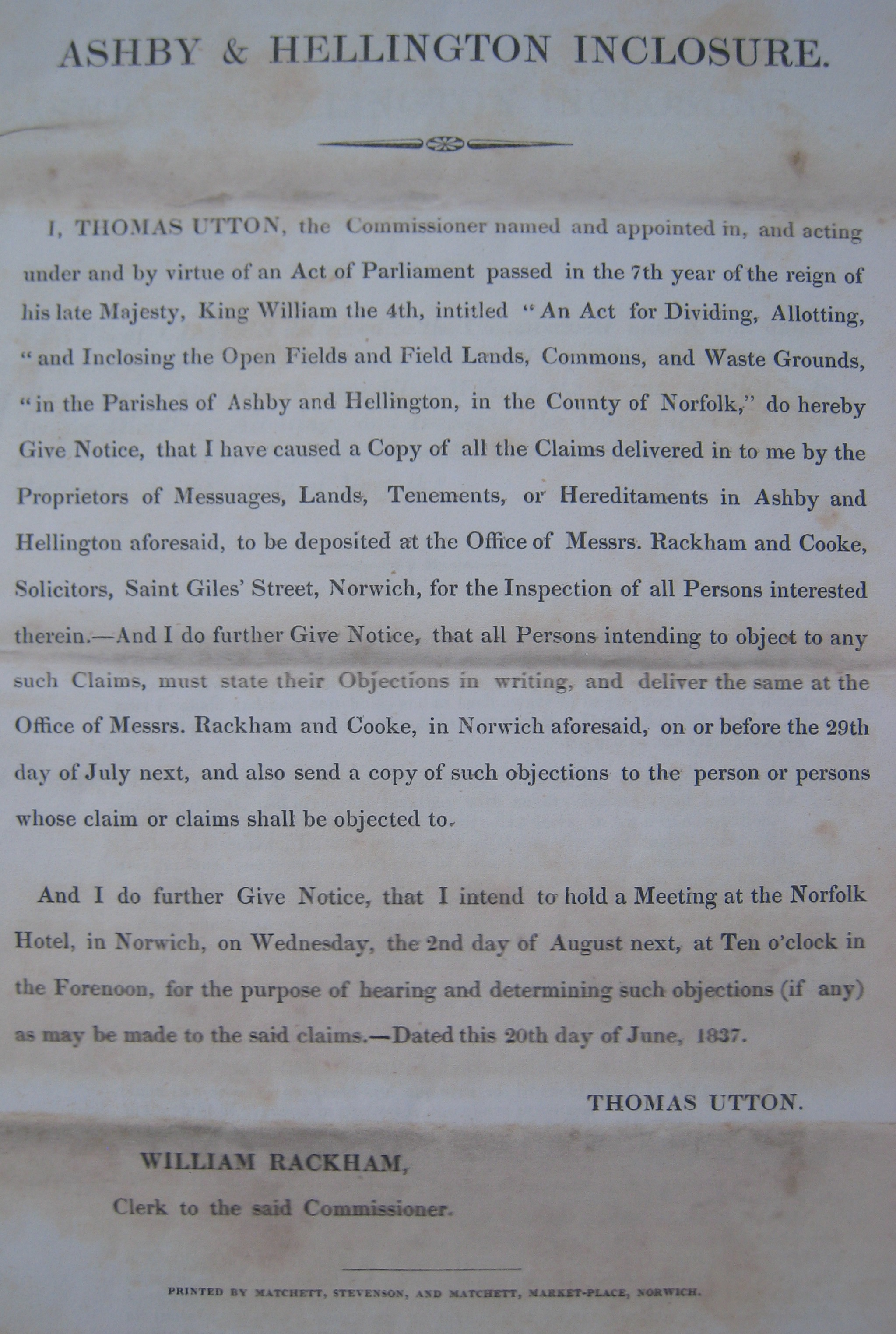
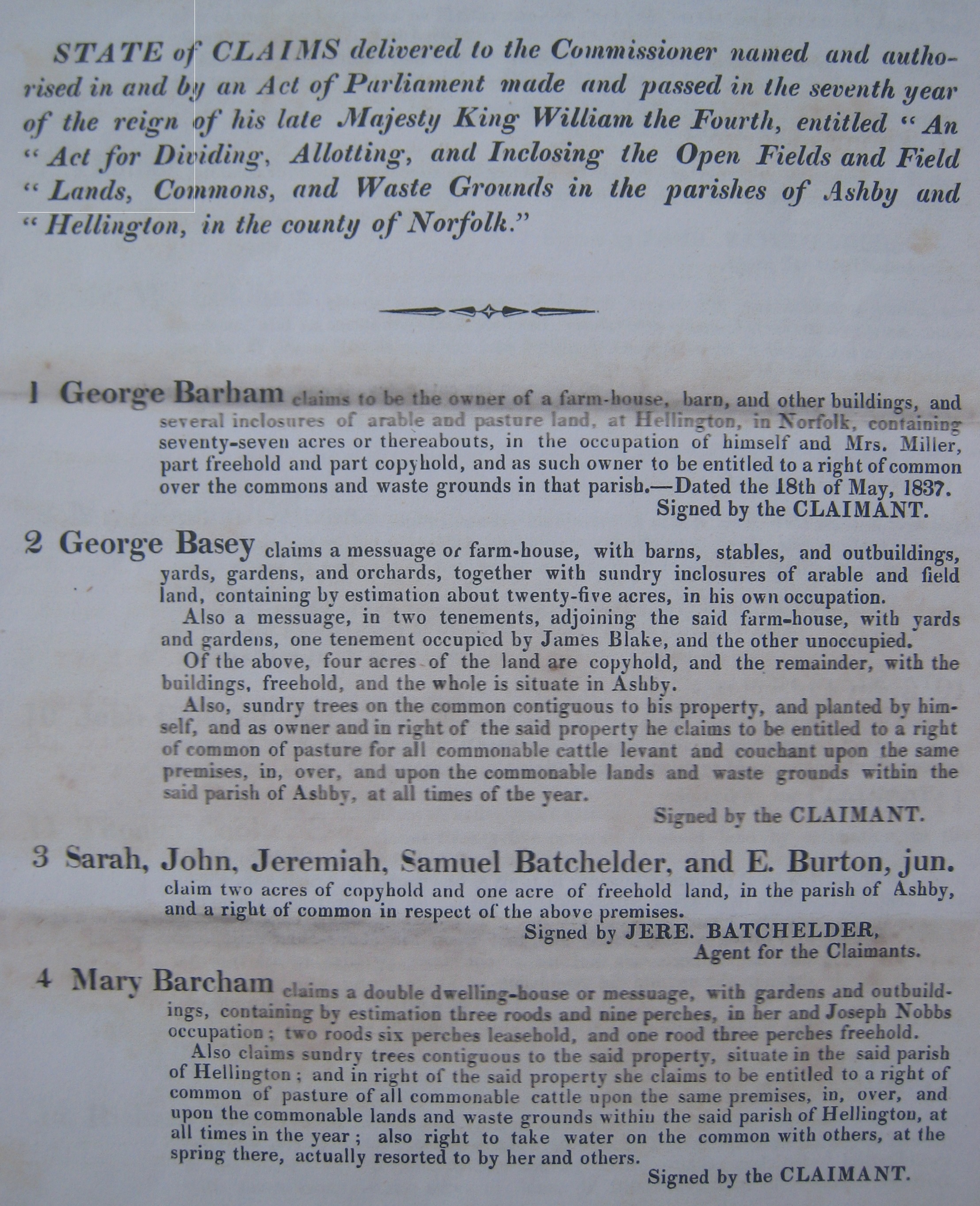
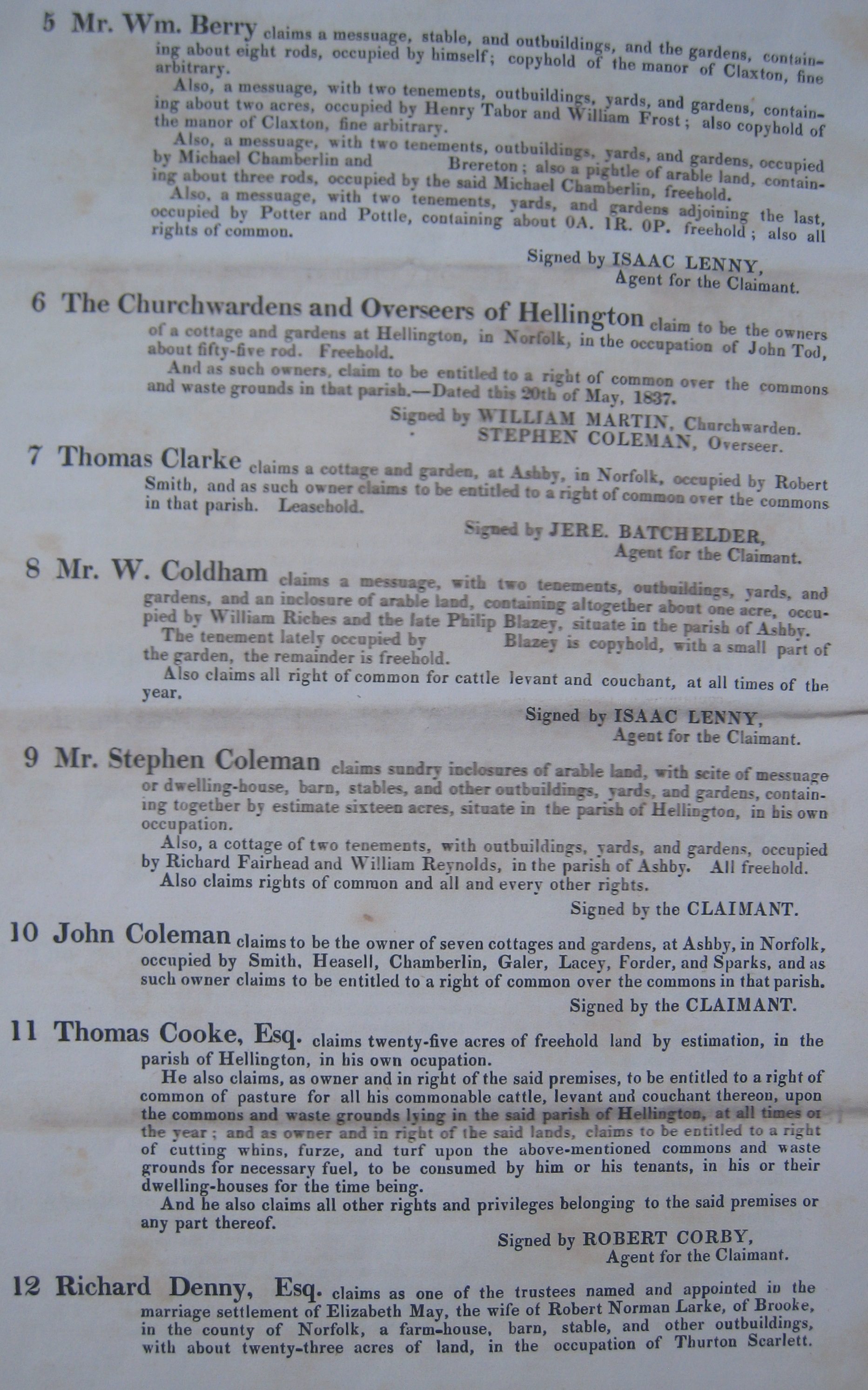
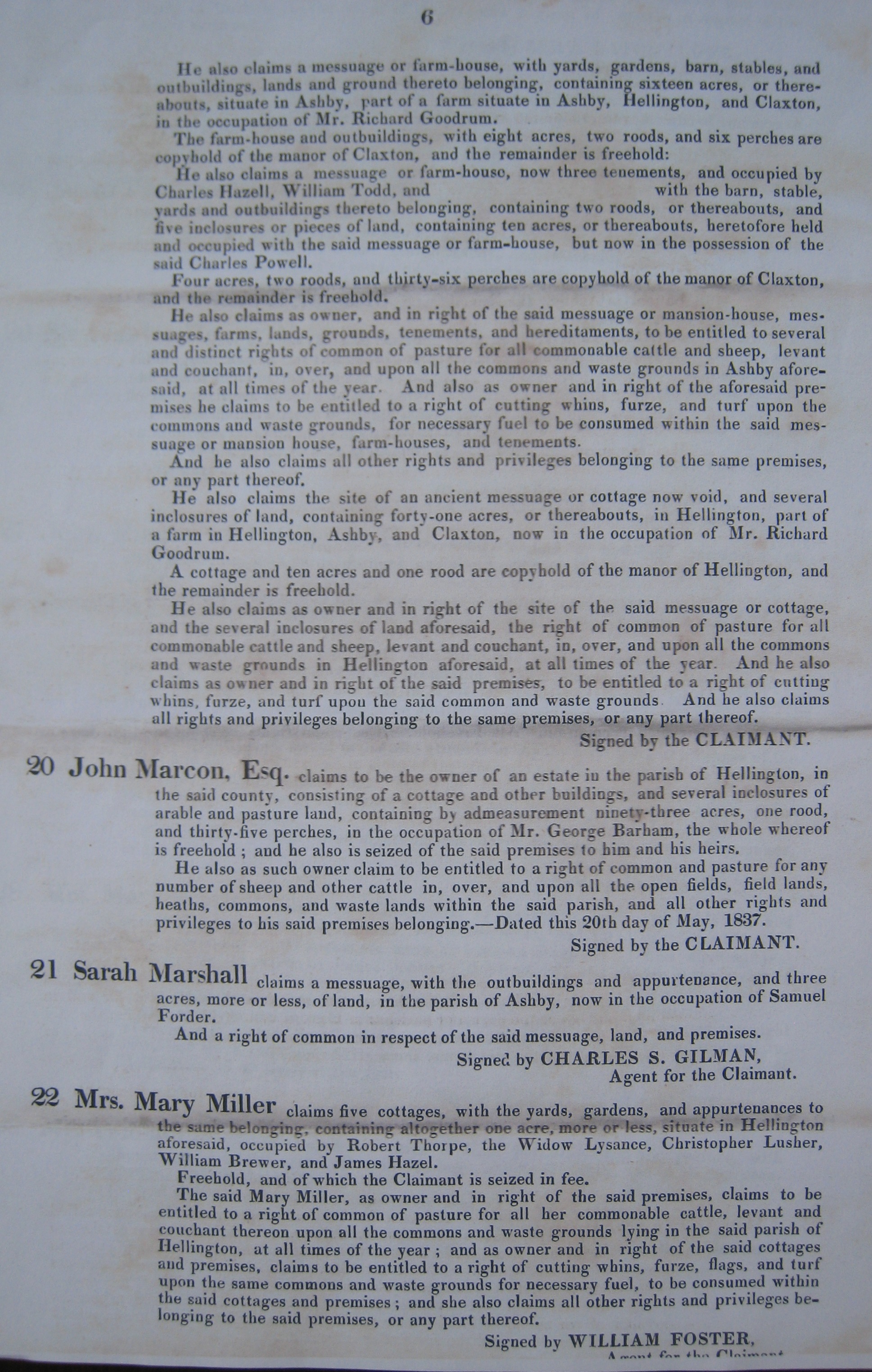
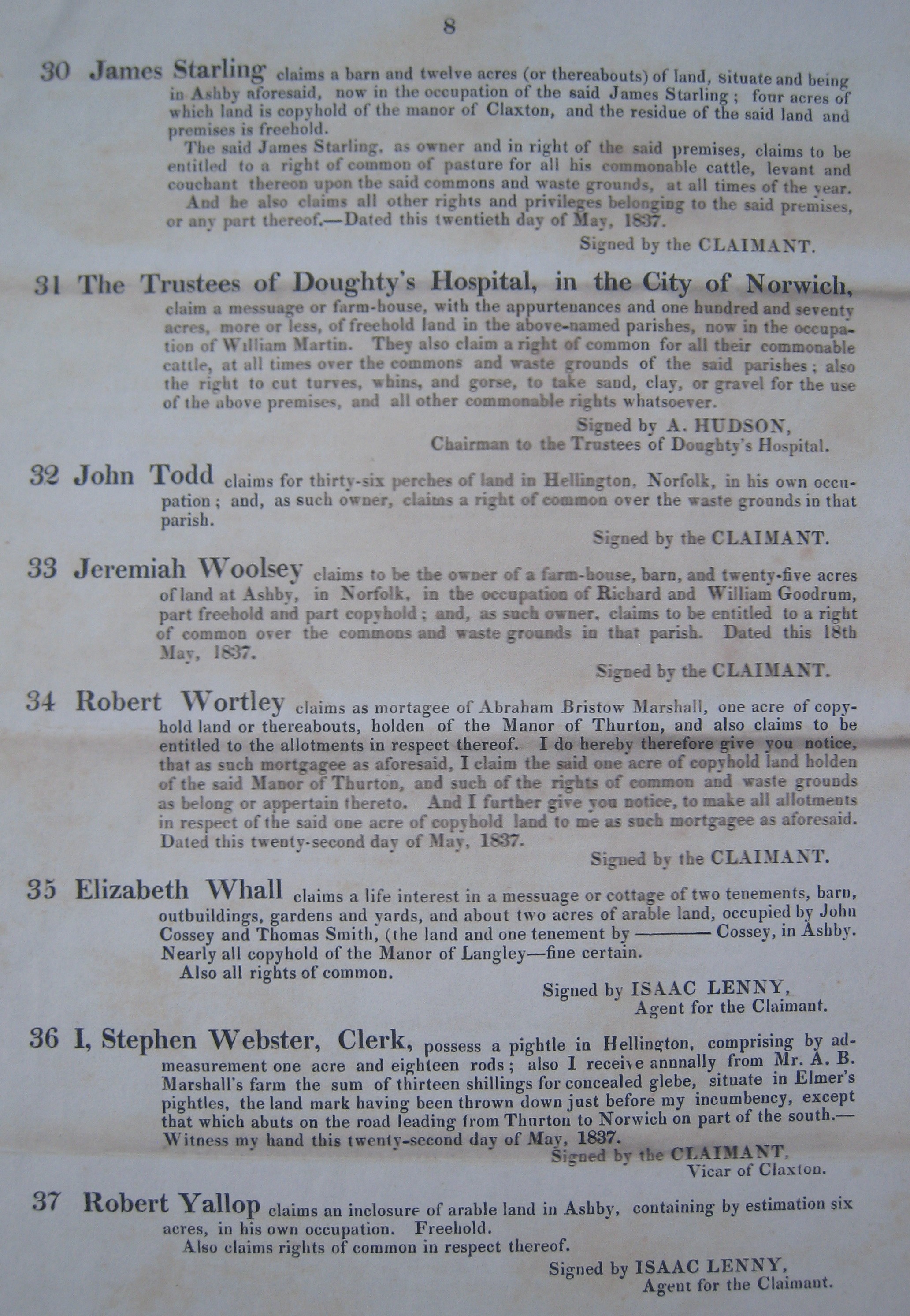
- 1837 ASHBY & HELLINGTON LAND CLAIMS 'An Act for Dividing, Allotting, and Inclosing
the Open Fileds and Open Lands, Commons, and Waste Grounds,
in the Parishes of Ashby and Hellington, in the parish
of Norfolk'.
If
you have any details to add to the background of these
documents please contact webmaster@ashbystmary.org.uk With grateful thanks to
parishioner Mike Carr for finding the Claims details
and forwarding them for parishioners interest.
- 1937 The following entry appears in Kelly's
Directory of Norfolk, 1937 (21st) edition:- "ASHBY ST. MARY (near Norwich) is a village
and parish, 71/2 miles from Norwich (Norwich Thorpe
being the most convenient station), 3 miles south-west
from Buckenham station (by ferry) on the Norwich, Yarmouth
and Lowestoft sections of the London and North Eastern
railway, and near the navigable Yare, and 31/2 north-west
from Loddon, in the Eastern division of the county,
Loddon hundred, Loddon and Clavering petty sessional
division, Loddon rural district, county court district
of Norwich, rural deanery of Brooke, archdeaconry of
Norfolk and diocese of Norwich.
The church of St. Mary the Virgin is an ancient structure
of flint in the Norman and Early English styles, consisting
of chancel, nave, south porch and an embattled western
tower containing 3 bells; the tower was restored in
1928 : the south porch is a fine specimen of Norman
work : the church was restored in 1849, and in 1903
the chancel was new-roofed and repaired : during the
progress of the work an ancient aumbry was discovered
in the north wall: in 1914 an organ was given by Mrs.
Wyndham Gray : the church has 120 sittings.
The register dates from the year 1620.
The living is a rectory, with the vicarage of Thurton
annexed, joint net yearly value £327, including
10 acres of glebe, with residence, in the gift of the
Governors of Wrekin College, and held since 1934 by
the Bev. Thomas Sewell Wontner M.A. of Selwyn College
and Ridley Hall, Cambridge.
The poor's allotment consists of about 6 acres, let
at £9 yearly.
The principal landowners are R. T. E. Gilbert esq. J.P.;
William H. M. Andrews esq. and the Rev. J. J. Woolsey
M.A.
The soil is light sandy ; subsoil, sand and brick earth.
The chief crops are wheat, oats and barley, sugar beet
and market garden produce. The area is 503 acres ; the
population in 1931 was 165.
Letters through Norwich, via Thurton. The nearest M.
O. office is at Bergh Apton & T. office, Loddon. PRIVATE
RESIDENTS
Andrews, William H. M., The Lodge / Child,
Miss, Ross Arden / Gilbert, Robert
Thomas Edwin J.P., Ashby hall
Ward, Miss, Ross Arden / Wontner,
Rev. Thomas Sewell M.A. (rector), Rectory
COMMERCIAL.
Basey-Fisher, George, farmer. Hill farm /
Catchpole, Leslie Wm., market gardener, Ashby villa
Catchpole, Nelson A., market gardener, Vally farm /
Cotton, Robert Major, farmer / Forder,
William, market gardener
Frost, Frank, market gardener / Gifford,
George, market gardener / Harwood, Bertie
John, market gardenr. Chapel rd
Hoddy, John, farmer & licensed horse slaughterer;
best prices given for live & dead horses & cattle,
Hill house. Thurton 23
Hurrell, Arthur. market gardener /
Parfltt W. & Sons, market gardeners, Grange Garden
house
Rich, Reginald Wm. saddler / Smith,
James, market gardener / Watkinson,
John Henry, market gardener
Whiles, Charles, market gardener /
White, Jas. Alfred, wheelwright"
(With acknowledgement to Kelly's Directories Ltd)
POPULATION At the 1841 Census it is recorded that “263
Souls” resided in the parish.
By 1861 there were 257 Inhabitants. For the next 100
years the population declined gradually.
In 1881 the figure was just over 200.
In 1901 it stood at 176, remaining reasonably static
for the next two decades.
The figure dropped to 165 in 1931 falling to a low point
of 155 in 1971.
By 1991, due largely to a development of newly constructed
dwellings, it had risen to 240 and rose again to 290
by 1998.
There are currently in the region of 300 inhabitants.
British Towns and Villages Network - This site claims to receive around 1.4 milion
hits per week. Following an invitation from the network,
it now contains a link to the Ashby St Mary website.
www.british-towns.net
UK Villages -
A community website for finding a wide variety of information.
www.ukvillages.co.uk
PARISH
REGISTERS -
Currently under construction Pages
from old Ashby parish registers dating from the 1500's
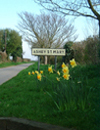
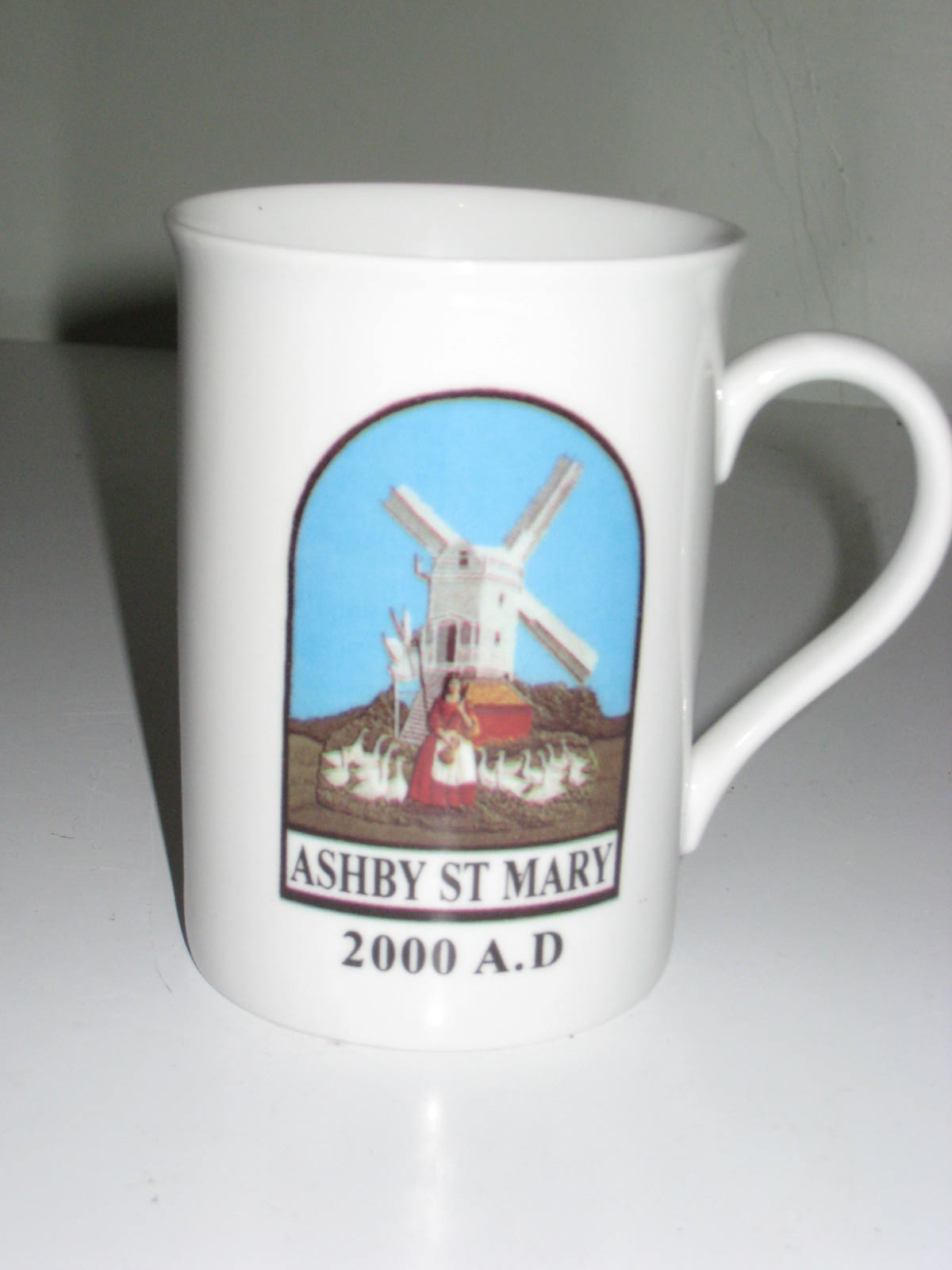
VILLAGE SIGN
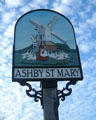
Commissioned
by Ashby St Mary Parish Council to celebrate the millennium,
the village sign was unveiled during 2000 (see Gallery
below for picture). Its entire nurture to life
and manufacture was fittingly provided by residents
of the parish. The particular design of the sign was
arrived at in the knowledge that history records a link
between the windmill, the Lady and the geese depicted
on it, to Ashby St Mary. It has been established that
it was the practice in the 18th and 19th centuries to
walk geese which had been bred in Norfolk to London
in readiness for the Michaelmas trade. For protection
their feet were bound with webbing and covered in tar.
This journey took some 10 to 14 days and they were fed
en route by grazing the corn stubbles.
A carving of a lady with geese is to be found on a tombstone
situated in Ashby churchyard (see Gallery below for
picture). Pictures of it have been published in
many books and magazines.
(With acknowledgement to parishioner
David Catchpole)
AROUND
ASHBY Click HERE
to see a gallery of some pictorial features of Ashby
St Mary parish
GALLERY Includes
details and pictures of events since 2007
2024 [JUNE]
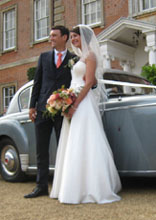
Marriage of Tim Rolph from Ashby St. Mary
On
Monday 3rd June
2024 the marriage
took place of Tim Rolph
and Emily Johnson. Tim
was 'born' in Ashby in 1987 where he
lived with his parents, Anita and Mark (who still live
in the parish), and his sister Nicola. Tim moved to
Norwich when he began
working for several motor and motorcycle dealerships
and it was while at a BMW motorcycle dealership
that he first met
Emily who worked at another motorcycle dealership right
next door! They subsequently moved to Snetterton
as Emily's employment
took her to the Dog's Trust charity premises, while
Tim maintained his motorcycle interest working
for Ducatti.
In beautiful
calm summer weather, the wedding ceremony and post-marriage
celebrations took place at Hockwold Hall near Brandon
and was attended by over 100 family members and friends
along with their perfectly-trained rescue dog,
Luna.
2024 [Green
Lane, on fringe of Ashby] Who can
forget the exceptional amount of rain our area suffered
up to and into April?Green Lane was closed
for weeks while the
solution to the regular road flooding was sought. These
photos were taken from a drone and are reproduced by
kind permission
of parishioner Robert Todd.
2024
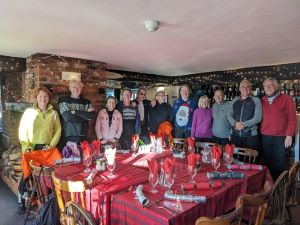
[January] - Ashby Amblers post Christmas lunch Fourteen
attendees at the long-awaited inaugural gathered at
The Ferry, Surlingham, sadly reduced from the aniticipated
nineteen due to
winter illnesses. Naturally it took place in the middle
of the group's weekly Tuesday ride. A delightful occasion
was had by all,
enjoying hearty lunches that for some included desserts
that simply could not be resisted. The company were
surprised when the
group's organiser distributed awards to colleagues that
he considered worthy of certiificates in categories
of 'Champion Hostess',
'Loud Hailer', 'Super Ambler', Leading Ambler', 'Where
are we going to', 'Most Improved Ambler', 'Swervyn
Mervyn', 'Most Bizarre Ambler' and finally, for the
most 'Spectacular Accident'. Following
lunch, the party rode home to conclude their Tuesday
ride, probably for many, a well-earned rest and recuperation.
“
2023[April] - Ashby Amblers Cycling Group Having
been formed in Easter 2022, the Ashby Amblers Cycling
Group enjoyed its first year by the same time in 2023.
The
group title describes the average sort of ride undertaken
- a meandering amble.
Having developed
from an initial two village cycling enthusiasts, the
group started to advertise its existence, first meeting
outside the village
hall entrance and later the more noticeable location,
outside Thurton's George & Dragon public house,
ready for its local
rides that take place every Tuesday morning from 0930.
Mostly by
word of mouth, the Ambler group has steadily grown to
over 20 cyclists who are not only from Ashby but those
from
Thurton, Claxton,
Rockland St Mary, Framingham Earl, Heckingham, Thurlton
and even Norwich have joined in its leisurely,
social rides. Friendships
have been made and endured as a result. Rides are about
20 miles in length that usually conclude
before lunchtime,
but very occasionally can go over 30 miles. Amblers
always have a 'coffee' stop en route for which over
20 establishments
have been identified and used for the all-important
R and R - refreshment and refuelling!
The Amblers
do not label themselves a club, more a friendly
group of like-minded enthusiasts, most of whom are aged
50+.
Adverse weather
does not automatically mean a ride is cancelled -
Amblers just dress accordingly - and only one ride has
ever been cancelled
since the group got together. One caveat - Norfolk and
Suffolk are not flat! It's got no hills, just inclines!
New participants
can be assured of being given a warm welcome whatever
their age, ability or type of bicycle they ride.
The Amblers ride
traditional bicycles, racing bikes, electric bikes and
even tamdems but the group has no unicyclists [yet]!
The group
always has a refreshment stop mid-route - believe it
or not there are over 20 different ones it uses.
For any more
information, email ashbywebmaster@gmail.com
with your details being sure to also include a mobile
number -
or why not meet
us next Tuesday (see above) and experience the sheer
pleasure of an Ashby Ambler ride for yourself!
2022 [September]
- New parish noticeboards New
noticeboards were recently erected by
Andrew Rudd, occasionally assisted by Mark Rolph
(Ashby parish councillor), at
Chapel Road (a replacement) and Spong Lane/Low Common
(an addition). The new boards are enclosed which
should mean the notices placed in them should survive
all weathers and be readable for longer. The boards
they replaced, despite being of heavy density wood
and very well made by a parishioner, were finally
surcoming to age. One had become unstable and was
therefore a safety risk but the other board was
in a sufficiently satisfactory condition to remain
in place for local groups to put their notices on
as desired.
2020 [April] - Announcement & Tribute to Edgar
Hoddy [1955 – 6th April
2020]
[On behalf of the Ashby St. Mary
parish council]
Edgar was elected onto the parish council from 16th
May 2003, serving his parishioners until his tragic
and untimely death. Reflecting his love of the countryside,
Edgar was perfect for role of the council's designated
responsible officer for footpaths and trees which
he took very seriously.
As well as a captain of a local darts team Edgar
was also a captain of the Buckenham Ferry 'A' pool
team, in the days when it existed. Both the 'A'
team and the Buckenham Ferry 'B' pool team, which
were based at the Beachamp Arms pub at Langley,
competed in the same local pool league. The captain
of the 'B' team recalled how, one year, in the annual
Captains Cup, he met the 'A' team captain - Edgar
- in the final at the Kings Head pub in Loddon.
In the best of three games Edgar needed to win the
second game, but despite leading it, luck deserted
him. Edgar inadvertantly caused the black ball to
be pocketed illegally resulting in him losing the
game and the match. The irony of this was that Buckenham
Ferry pub still benefited from being the winners
of the Captains Cup but just not in the way Edgar
would have wanted it! Ever the gentleman, Edgar
congratulated his vanquisher by warmly shaking,
not his hand, but his throat! The Ashby webmaster
was his opponent.
The countryside experience Edgar afforded the parish
council will be almost impossible to replace from
within Ashby's close community. The parish
council extends its heartfelt condolences to all
his family and friends. Ashby has truly lost a giant
of a character.
[With acknowledgement to the Eastern
Daily Press] "Passed away at the Norfolk and Norwich
Hospital on April 6th, 2020, aged 64 years. Much
loved and sadly missed by all his family and friends.
Due to the current situation, there will be a private
burial for family members only. Details of a memorial
service will be announced at a later date."
[With acknowledgement
to the Broads Authority] "Tributes have been paid to a “gentle
giant” with an encyclopaedic knowledge of the
Norfolk countryside, who spent many years as a countryside
ranger.
Edgar Hoddy was born and bred in Norfolk and lived
in Ashby St Mary for the duration of his life.
He went to school in Loddon before joining the family
business, Hoddy Brothers Farm, at the age of 14, and
worked all over East Anglia.
In 2002, Mr Hoddy volunteered with the Broads Authority
for three months and was soon offered a job as a countryside
ranger, a position he held for 17 years until his
retirement.
A much-loved employee at the Broads Authority, where
he largely worked on patrol boats, Mr Hoddy was famed
for dressing as Santa Claus
every Christmas throughout his career.
John Packman, chief executive of the Broads Authority,
said: “Edgar was a huge personality within the
ranger team. He was well known for the ‘Edgar
lean’, propping himself against
a gate or fence at Whitlingham Country Park whilst
he regaled tales and anecdotes of his time in the
Broads, especially his daring rescues. He will be
greatly missed by many in the Broads.”
Mr Hoddy, who was known as a fantastic teacher, ran
a forestry school for disadvantaged children at Whitlingham,
where lessons, which focussed on basic skills for
adult life, included woodwork, tree felling and bow-making.
Outside of work, Mr Hoddy was a captain for a local
darts teams and enjoyed long family drives in the
countryside, which he knew like the back of his hand,
accompanied with binoculars for wildlife-watching.
He was married to Lesley Hoddy, who passed away four
years ago, for 29 years, and had a daughter, Lucy,
and a stepson, Andrew.
Lucy Hoddy said:
“He was a wonderful and devoted father and I
could ask him for guidance on anything and he was
so proud of anything I achieved. Everyone adored him
in the community and every time he went to a pub everyone
would try and buy him a drink. He was a gentle giant
and the most generous and kind person I have met.”
Mr Hoddy passed away in hospital this month after
suffering from health problems, at the age of 64."
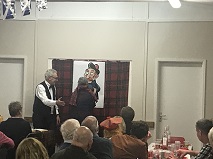
2020 (January) Burns Night Supper
The traditional Burns Night Supper was held
at Ashby St Mary and Thurton Village Hall
on Saturday 25th January 2020.
As can be seen, the
event was sold out. The evening included the
Management Committee Supremo, Carol Powell,
parading the haggis and Pinning-The-Sporran
proved
quite a success. Management Committee member
Steve Read was compere for this traditional
annual occasion.
With
thanks to all those who attended to support
the evening.
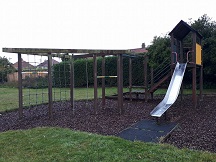
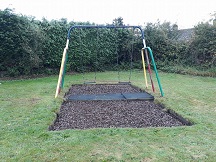
2019 (April) Grand Opening of Ashby & Thurton
Playground Project
On
Friday 5th April 2019 the Grand Opening took
place of the Ashby St. Mary & Thurton Village
Hall Playground Project. Stemming from an idea
of local mums who wanted to see better, safer
and more playground items for local children
to enjoy and play on, their long awaited aim
finally came to fruition. It took much planning,
lots of fund-raising and hard work by a lot
of people, chiefly from the two villages, before
the big day arrived.
The screams of delight from the children when
they were let loose on the new apparatus could,
allegedly, be heard miles away. Very well done
to all concerned. So what's next?!
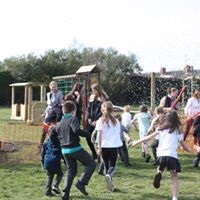
Below can be seen The Ideas Department; Ashby
TAPPers fundraising cyclists; some of the new
playground equipment; and children on the opening
day.
2018 (October) Harvest Supper
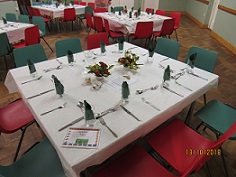
A harvest supper was held at Ashby St Mary
and Thurton Village Hall on Saturday 13th
October 2018.
Forty Eight local residents attended and enjoyed
the main courses of Cottage Pie, Lasagna,
Chicken Curry, Fish Pie and Beef Bourgignon
all cooked by our splendid Lady Chefs in Ashby
St Mary.
Second and some third helpings ensured that
nearly all the main courses and desserts disappeared
during the evening.
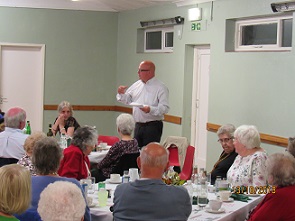
The food was then followed by a talk by Chris
Bailey whose entertaining discourse on hosting
major music events in Norfolk and across the
UK completed an enjoyable evening.
The event and donations resulted in a magnificent
£1,005 being added to St Mary’s
Church accounts.
Many thanks to our chefs and all who helped
in preparing for the event.
A special thanks to all those who attended
and helped clear and clean the hall at the
end of the evening.
A true community effort. [Terry Kitt]
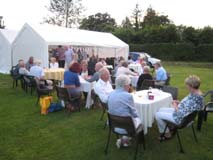
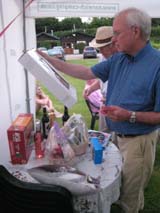
2016 (July) Strawberries and Cream
Saturday 23rd July saw the annual evening
of parish gluttons feasting in aid of Ashby
church funds. Blessed with fine dry weather,
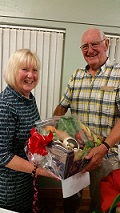
the usual fund-raising took place with whisky
squares, raffle, tombola and even an impromptu
auction. Pictures show the ensemble,
Arnold inspecting his raffle win and it was
difficult to miss our roving reporter promoting
strawberries and cream in that top! Ben and
Jess at Woodland Stoves, the event hosts,
provided the perfect venue for the occasion
for whom, along with all the organisers, a
vote of thanks was enthusiastically endorsed
by everyone.
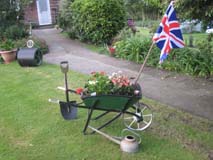
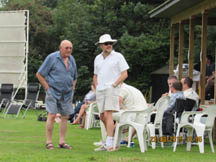
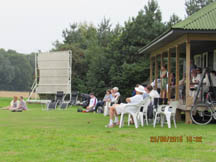
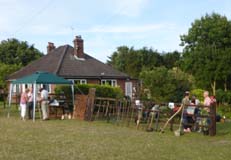
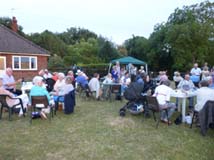
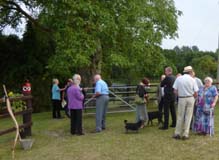
2016 (June) Ashby Cheese and Wine
The annual Cheese
and Wine gathering took place on Saturday 23rd
June at the home of hosts Mike and Wendy. Held
in aid of Ashby church, its funds will indeed
have been swelled as a large contingent of villagers
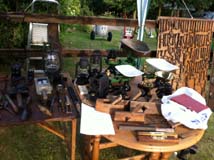
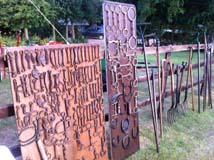
eagerly tucked in to the majestic spread on
offer. Visual attractions included a range of
restored agricultural implements and a static
cricket match (see pictures) - definitely not
your average party animals! The occasion was
happily rain-free and the evening was clearly
much enjoyed by all.
A vote of thanks to the hosts was given by winemeister
for the evening, Terry Kitt.
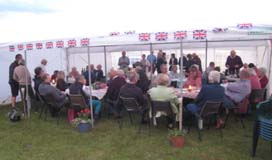
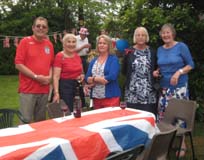
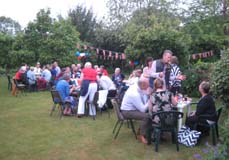
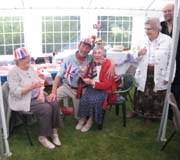
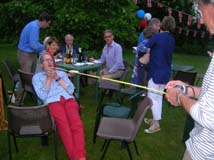
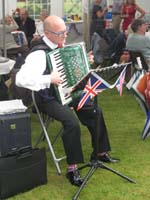
2016 (June) 'Ashby St. Mary Street Party' in Celebration
of Her Majesty the Queen's 90th birthday
Saturday
11th June saw over 60 residents gathered for
an Ashby St Mary Street Party to celebrate
the 90th birthday of Her Majesty Queen Elizabeth
11. A very wet start eventually gave
way to a pleasant evening of food (thanks
Jim Le Chef), refreshments (thanks Ashby ladies),
accordian accompaniment from Alan Sissions,
and recreational games at the end of which
(in keeping with the occasion) a royal toast
was offered and the national anthem sung.
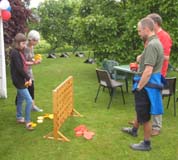
Connect 4, badminton, swingball and croquet
were all played along with the extraordinary
sight of a malteser challenge. Using
a steel tape measure, the challenge was to
see how far a malteser could travel to be
caught in a recipients mouth without falling
from the tape measure! After several (independently
witnessed) attempts the Todd family reigned
supreme with the female members outshining
their male counterparts, the winner being
Maria achieving 15' 3"! If only
Her Majesty could have been there to witness
it - or have a go!
Thanks to the hosts, David and Betty, and
their army of Ashby helpers (too many to mention)
for a truly memorable celebration. Next up
- the 100th!
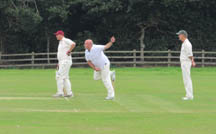
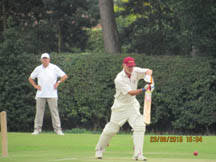
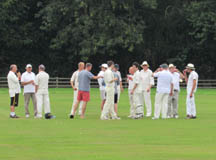
2015 [August} Ashby CC v Ashby Xl Cricket Match for
the Roy Roebuck Cup
2015 [August] Marriage of Nicola Rolph from Ashby
St Mary
On
Saturday 15th August the marriage took place
of Nicola Rolph and Yanto Barker.
Nicola was 'born' in Ashby in 1984 where she
lived with her parents, Anita and Mark (who
still live in the parish), and her brother Tim.
Nicola left Ashby when she studied
for a degree at Sheffield University and has
lived in London since 2011. She works for UK
Sport, the country's governing body for sport,
and her husband is a successful professional
cyclist and manufacterer of sports clothing.
In beautiful calm summer weather, the wedding
ceremony and post-marriage celebrations took
place at Kimberley Hall near Wymondham and was
attended by over 100 family members and friends.
2015 [July] Annual Strawberries & Pimms - with
a difference....
On
Saturday 4th July, fabulous weather ensured
an excellent attendance of villagers enjoyed
the annual event that is the favourite of many.
Hosts Mike and Wendy made everyone very welcome,
supplemented by Mike's wonderful display of
largely former agricultural implements, all
neatly on display for villagers to view. They
brought back a good few memories for some!
It was the first fundraiser event for Ashby's
new vicar, Chris Ellis and he will certainly
attend again as he pulled his own raffle ticket
as a winner! £722, a record it is
understood, was made on the night in aid of
supporting Ashby church funds. Thanks go to
all those who helped in the organisation of
the occasion and especially to Mike and Wendy
for their hospitality and efforts.
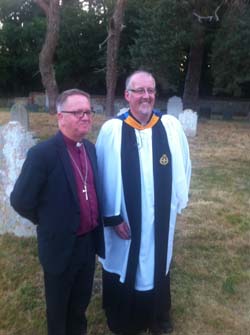
2015 [June] Induction of Reverend Christopher Ellis,
Ashby's new vicar.
On Tuesday 30th June over 200 residents of the
villages of Ashby St Mary, Thurton, Bergh Apton,
Framingham Pigot and Alpington with Yelverton
attended the Induction at Bergh Apton Church
of the Reverend Christopher Ellis as Rector
of the Thurton Benefice. The induction was held
in the presence of the Rt Revd Alan Winton,
Bishop of Thetford and Ven. Stephen Betts, Rural
Deacon.
Symbols of his Ministry were presented to Christopher
by representatives of each village. Ashby presented
water for the Font as a symbol for Baptism.
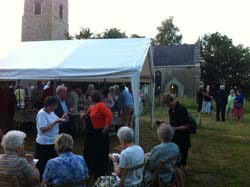
After the service the congregation was invited
to take refreshments in a marquee erected in
the churchyard.
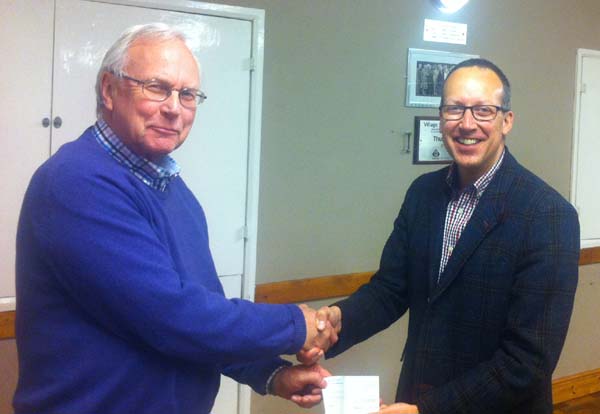
2015 [May] - Parish Council assists Ashby church project
The much publicised donation by Anglian Water
Authority to each parish affected by the lack
of a water supply in January 2015 is to help
finance the enticingly named 'Ashby church
loo fund' project. The donation of £1000
sent to the parish council was handed over
at Ashby's Annual Parish Meeting in May.
Ashby church's grateful representative, Arnold
Miller (left) receives the donation from council
chairman, Robert Todd.
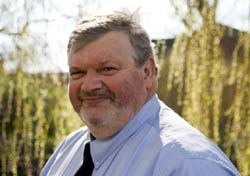
2015 - Parish councillor Edgar Hoddy rescues family
in Broads boat drama [16th April] [Acknowledgement to Eastern Daily Press
- edited account]
Donal
MacGarry, his wife, their daughter and grandson,
were enjoying a day on the water in their
rowing skiff yesterday when they hit a wooden
stake. Architect Mr MacGarry, from Kirby Bedon,
said the stake tore through the 60-year-old
timber boat at about 1.30pm outside the channel
near Rockland Broad. As the drama unfolded,
all the family could do was wait as they stood
beyond their waists in water. Broads
Authority ranger Edgar Hoddy 59, of Ashby
St Mary, arrived just in time and pulled the
group to safety.
Now Mr MacGarry said he wants to thank Mr
Hoddy. He said: “He rescued us single-handedly
and was just great. He got most of our belongings
out too and even after that the rangers went
back to help me salvage the boat and oars.”
Mr Hoddy (left) said it wasn’t until
afterwards that he fully appreciated what
he had done and the danger the family were
in. He said: “I was just
doing my job and didn’t think about
much more. But I woke up early the next morning
thinking about them in the water with just
their heads visible and realised how bad the
situation could have been, especially as two
of the family weren’t wearing life-jackets.
They were in quite some distress but were
very grateful when I got them onto the launch
safe and sound.”
2015 - A Tribute to Roy Roebuck [Kindly
provided by David Catchpole] [1st February 1945 – 18th February
2015]
Many
villagers were somewhat stunned and extremely
saddened at the sudden death of Roy Roebuck
who passed away on 18th February 2015, aged
70 years. Having been born in Sheffield, Yorkshire,
he first came to Norfolk when he was appointed
Chief Engineer at Reckitt & Colman of
Norwich. His next appointment was as Chief
Engineer at Christian Salvesen of Oulton Broad,
subsequently becoming a director of that company,
a position which involved him travelling the
length and breadth of the UK as well as many
countries overseas. He was a Past President
of the Engineering Society. Being
quietly proud of his Yorkshire roots, he was
a member of the Yorkshire County Cricket Club,
always following the fortunes of his county
side as well as the national team, whose form
recently had not given him much pleasure.
He was currently Vice-Chairman
of the Chet Valley Probus Club and should have commenced
his year as Chairman in April. With his father having
been an aircraft engineer working on Lancaster Bombers
during World War II, Roy took a keen interest in
aircraft and to this end had given illustrated talks
on The Spitfire. Similarly with his engineering
interest he gave talks on The Life & Works of
Isambard Kingdom Brunel.
Since his retirement,
together with his wife Margaret, he had been a driving
force in fundraising towards the upkeep of the Parish
Church. He successfully applied for grants towards
the restoration of the Church Bells and for the
last 4 years had been Churchwarden. His administrative
skills in that post will be sorely missed.
For the last 10/12
years, each October, Roy, would begin the time consuming
task of decorating his garden with Christmas illuminations.
The ‘Annual Switch On’ at the beginning
of December was an event much looked forward to
by both parish children and adults alike. Each
night during December these colourful displays brought
joy to people far and wide. At the funeral,
Arnold Miller who gave the Eulogy, said ‘there
will be a dark corner in the Parish this coming
December’. 200 people attended
Roy’s funeral, held in Ashby St Mary Church
on the 5th March.
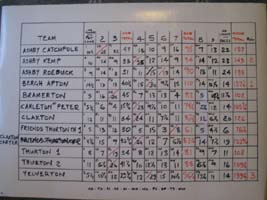
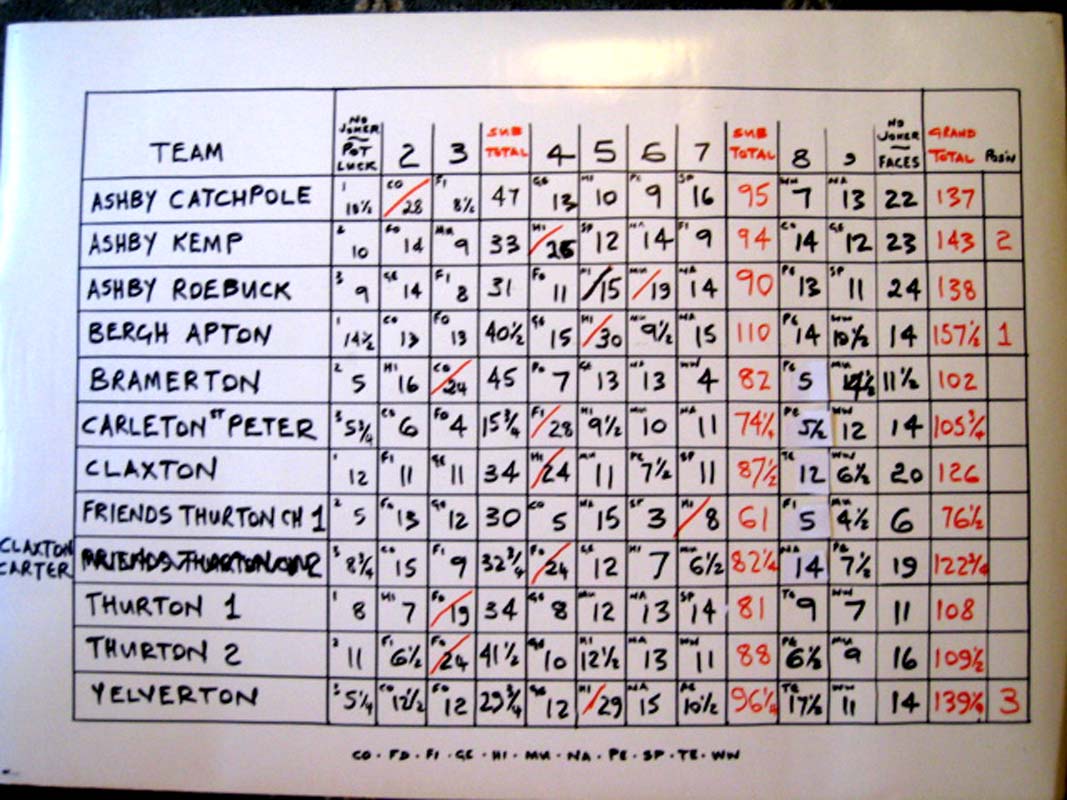
2014 - Bramerton Group Quiz On Saturday 17th May, 11 teams of eager
competitors representing teams from Ashby St Mary,
Bergh Apton, Bramerton, Carleton St Peter, Claxton,
Thurton and Yelverton took part in the annual Group
Quix night. It was held in the Ashby & Thurton
Village Hall by virtue of it being the 'home' venue
of Ashby Roebuck, last year's winning team, In a
slightly unusual approach, teams had to select their
favoured 8 subjects from 11 that were on offer,
plus being given a pot luck section added to which
was a Faces section for answering during the whole
evening. Armed with considerable quantities of liquid
refreshment and brainpower, the teams bravely tackled
the tasks set them and could watch how they were
progressing as the section scores were added to
a large scoreboard. Bergh Apton triumphed in 1st
place by an impressive margin but as can be seen
below, the next 3 places were separated by only
2 1/4 points which proved how critical the decision
was, of when and for which subject, to play their
joker (double points).
The
teams
and
players
Victorious
Bergh Apton captain (left)
Final
scoreboard
[Click
HERE
for a larger picture of the scoreboard]
2014
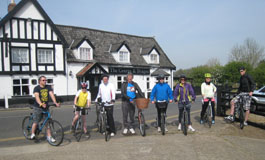
- Cycling For Fun! - Easter Monday
21 April
Your webmaster, Mark, was joined by a total
of 8 other cyclists (Nicola Roffey, Tim Rolph,
Robert Todd [Ashby Parish Council chairman]
and his family, Maria, Sophie and Sam, all from
Ashby, and Keith and Julie Lincoln from Thurton)
for the gentle 7 mile local cycle ride on Easter
Monday.
The route went on quiet roads from outside the
George & Dragon PH at Thurton via Alpington,
Yelverton and Bergh Apton and included a stop
for refreshments. The earlier anticipated poor
weather did not materialise and turned out to
be perfect cycling conditions - sunny and only
a light breeze. All agreed another ride should
be arranged so look out for news of this on
Ashby's noticeboards or contact me at webmaster@ashbystmary.org
With thanks to the above named who made the
all too brief occasion the success it turned
out to be.
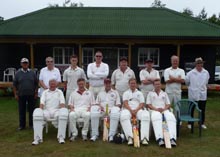
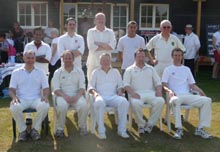
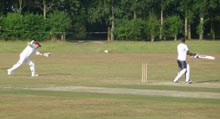
2013 - Bishop's X1 v an Ashby X1 Charity Cricket
match was held on 27th July between teams of the Bishop
of Thetford and Ashby in a 26 overs per side innings.
The weather forecast had predicted rain for a large
part of the day, but it turned out to be a mainly
warm, sunny, summmer day.
The Ashby team, which included village guest players,
batted first and made a very respectable total of
180 all out after which 'tea' was taken by the palyers.
In reply the Bishop's X1 made 78 and never looked
like gaining the upperhand during their innings although
a fine caught-and-bowled by the Bishop must surely
have meant he went home happy!
The
Ashby X1
The Bishop's X1
A
fine stop (look closely)
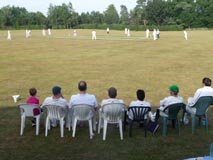
Ashby's
very own 'Barmy Army'?!
Bishop's batsmen watch Ashby fielders
At the conclusion a barbeque and raffle was held for
all the players and the many watching spectators.
Other highlights included a 6 into the grounds of
Ashby Hall, a 4 which resulted in a 'lost' ball amongst
the cars and a dog surprised by another 4 despite
minding its own business.
LOOK BELOW - Click on a play arrow to watch
some cricketing action*. In both videos the Bishop's X1 are batting
and the Ashby X1 are fielding - one shows a wicket
being taken. Click the centre arrow to start. To view
again, click the symbol at the the lower left
corner. To avoid the vocal accompaniment of several
excitable children and snatches of spectator converstions,
you may wish to turn your volume down or off!
(The assistance of Andy O'Connor is gratefully acknowledged
in providing his technical assistance)
* Please note - this will operate only if you
have suitable software.
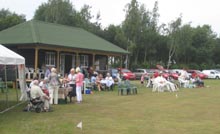
2013
- The village Strawberries
and Pimm's event held on Friday 28th
June took place amidst the wonderful surroundings
of the Ashby Cricket Club with its magnificent
new pavilion.